
License for General Contractor in Ontario: What Clients Check
There is no single license for general contractor work on Ontario commercial projects. See the four checks that matter: WSIB, ESA, trades and insurance.

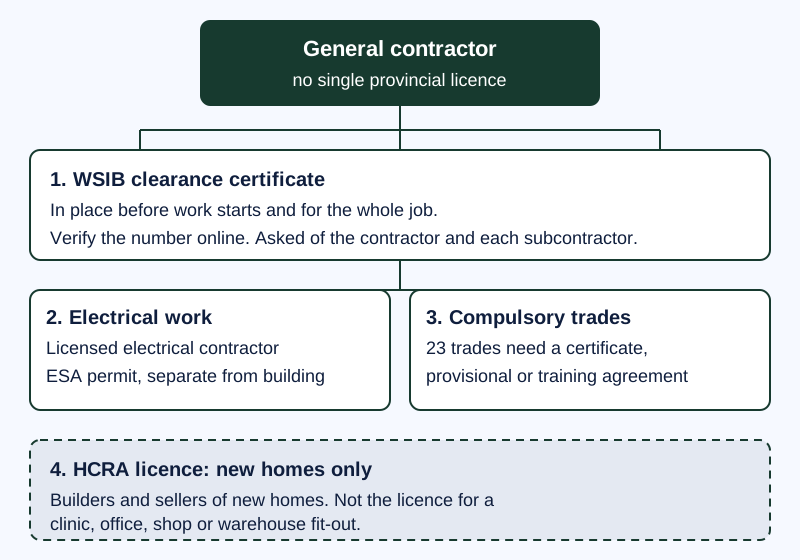
There is no single provincial license for general contractor work on a commercial building in Ontario. What a client should check instead is the contractor's WSIB clearance, licensed electrical contractors, certified tradespeople in compulsory trades and proof of insurance. The one licence people mention, from the HCRA, covers new homes only.
This guide is for tenants, owners and property managers in Toronto and the GTA who are choosing a builder for an office, clinic, shop, restaurant or industrial space. We explain each check in plain steps, so you can ask for the right papers before you sign. If you are comparing builders now, see our commercial general contractor page.
The checks matter because a missing one lands on you, not only on the contractor. A clear list takes about an hour to run and replaces a lot of guessing.
Does a general contractor need a license in Ontario?
For commercial work, no general one. Ontario does not hand out a single "general contractor" license the way it licenses some trades. The company is held to account through the building permit, the Ontario Building Code, workplace safety law, workers' compensation coverage and the licences of the trades it hires.
That is why a client's job is to check the pieces. A contractor can be fully lawful and still be wrong for your building, so the checks below are the minimum, not the whole decision. Our ICI construction guide explains how the project type changes who you need on the team.
What is the WSIB clearance certificate, and why ask for it first?
The WSIB says clearances must be in place before any construction work begins and for the duration of the work. Of all the papers, this one carries the most weight, because the WSIB states that both the principal and the contractor have legal obligations regarding clearances.
The WSIB clearance FAQ also explains that a contractor who hires a subcontractor becomes the principal for that work. So ask your general contractor how it checks its own trades. It says that if work proceeds without a valid clearance number, both the contractor and the person or company who hired them commit an offence under the Act.
- Ask for the clearance certificate number, then verify it through the WSIB online services.
- Check that the business name matches the company on the contract.
- Look at the dates and diarize the renewal if the job will run long.
Which trades need their own license or certificate?
Skilled Trades Ontario states that anyone working in one of Ontario's 23 compulsory trades must hold a valid certificate of qualification, a provisional certificate of qualification or a registered training agreement. The page names plumber, electrician and steamfitter among them.
The compulsory trades page is the authority, so use it, not a contractor's say-so. A general contractor does not need one of those certificates just to manage a job, but the people doing the trade work on it do. On a build-out that usually means electrical, plumbing and heating or cooling.
How do you check electrical work on a commercial job?
The Electrical Safety Authority (ESA) says a general contractor should make sure electrical work is done by a licensed electrical contractor and that the work is permitted by ESA. Electrical work needs its own permit, separate from the general building permit.
Read the ESA page for general contractors before the pre-construction meeting. Two practical checks follow. Ask who files the notification of work, and ask who will hold the final ESA approval. An electrician who tells you that you do not need an ESA permit is a warning sign, because the ESA lists exactly that as a red flag.
Is the HCRA license the one I need?
No, not for commercial space. The Home Construction Regulatory Authority says all new home builders and sellers are required by law to be licensed, and its page describes a new home as a family dwelling used for residential purposes. See its licence guide.
The page does not mention commercial or industrial buildings, so it is not the licence for a clinic, office or warehouse. If your project includes new residential units, such as an apartment above a shop, ask the HCRA directly which rules apply. Some bloggers claim every Ontario contractor needs this licence. That is not what the regulator says.
What do the lease and lender add?
Insurance is where the paper trail often lives. No licence sets it. Your lease, your lender or the tender documents usually say what liability coverage the contractor must carry, and a landlord may add its own rules for contractors working in the building.
Ask for a certificate of insurance before work starts, and check that it matches what the lease requires. If you are a tenant, send the landlord's contractor rules to every bidder at the start. Tenant improvements often stall at this step, not because the contractor is unqualified but because the paperwork does not match the lease.
Holdback is the other money check. The Construction Act defines the holdback as 10 per cent of the value of the services or materials supplied under a contract or subcontract, which Part IV requires the payer to withhold. Ask your contractor and your lawyer how that will be handled in your contract.
| Check | What to ask for | Who sets it | Applies to commercial work? |
|---|---|---|---|
| WSIB clearance | Certificate number, verified online, dates covering the job | WSIB | Yes |
| Electrical contractor | Name of the licensed electrical contractor and ESA permit plan | ESA | Yes |
| Compulsory trades | Certificate of qualification or provisional certificate per tradesperson | Skilled Trades Ontario | Yes |
| Insurance | Certificate of insurance matching the lease and lender terms | Your contract, lease, lender | Yes |
| HCRA licence | Licence number, for new homes only | HCRA | No, unless homes are built |
What should you have ready before calling a contractor?
Gather the address, intended use, size of the space, the lease or landlord rules, your target date and any drawings. Then ask each bidder for the same four papers, so the answers are easy to compare. A contractor who can show them in one email is already easier to work with.
- WSIB clearance certificate number and dates.
- The licensed electrical contractor it will use, and who files the ESA notification.
- Confirmation that every compulsory trade on the job holds the right certificate.
- A certificate of insurance that matches your lease or lender.
- Its plan for permits, inspections and your landlord's rules.
Should you choose design-build or a separate designer?
The licensing picture is the same either way, because the checks attach to the contractor and its trades. What changes is who coordinates. In design-build construction one team holds design and construction, so you ask one company for the papers. With a separate designer you also confirm the design professional's registration. Either way the building permit and Code review happen before work starts.
What mistakes do owners make when checking a contractor?
Three come up often. Trusting a verbal answer about WSIB, when the number takes minutes to verify. Assuming a home builder licence proves commercial experience, when the HCRA page covers new homes. And checking once at signing, then never again, even though clearances and permits have dates.
For a regulated space such as a dental or clinic suite, add the rules from your own college or regulator to the list. Our guide to renovating a medical clinic in Ontario shows what those add, and our medical clinic renovation page covers the build side. For an office renovation, landlord rules and after-hours access usually matter most.
How do these checks fit together?
Think of it as a short chain. The WSIB check protects you from liability for unpaid premiums. The ESA check protects the building and the occupants. The trade certificate check protects the quality of regulated work. Insurance and holdback protect your money. None of them replaces the building permit, which is the municipality's approval that the work meets the Ontario Building Code.
Ready to ask for a written quote? Contact us with the address, your intended use, the size of the space and your lease dates, and we will tell you what we need next. You can also read about our ICI construction work.
Frequently asked questions
Does a general contractor need a license in Ontario?
Not a general one for commercial work. Ontario does not issue a single provincial license to general contractors, so what a client checks is the contractor's WSIB clearance, licensed electrical contractors, certified tradespeople in compulsory trades and proof of insurance. A municipal permit for the project is a separate matter.
Does the HCRA license apply to commercial renovations?
The Home Construction Regulatory Authority says all new home builders and sellers must be licensed, and its definition of a new home describes a family dwelling. A clinic, office, shop or warehouse is not that. If your building has residential units, ask the HCRA directly.
How do I check a WSIB clearance certificate?
Ask the contractor for the clearance certificate number and verify it through the WSIB online services before work starts. WSIB says clearances must be in place before any construction work begins and for the duration of the work. Repeat the check if the job runs past the certificate's end date.
Who must hold a certificate of qualification on my project?
Anyone working in one of Ontario's 23 compulsory trades, such as electrician, plumber or steamfitter, must hold a certificate of qualification, a provisional certificate or a registered training agreement. The general contractor does not need one unless it also does that trade itself. Ask each trade on the job to confirm.
Is insurance a license requirement?
No. Insurance is a contract and lease requirement, not a license. Your lease, lender or tender documents usually say what coverage the contractor must carry, so ask for a certificate of insurance that matches them before work begins.
Get a quote for your project
Tell us about the site, the scope, and your timeline. We review it and reply with the next step.